


Diesel gelling rarely starts on the morning your truck won’t run. It starts days earlier, when cold nights pull wax out of the fuel and that wax settles into your filter. By the time you notice a problem, the damage is in the tank.
You already know what gelling is, so I will skip the basics. This guide covers timing. I want you to leave with a clear trigger for when to treat your fuel, a dose for each temperature range, and a short checklist to follow each fall.
The main rule is simple. An anti-gel works best when it goes into fuel that has not yet gelled. If you want the full background on when to use diesel anti gel, Howes Products cover it on their blog, and I build on that same idea here. I chose the products below for their clear directions, their range of sizes, and the support they offer the driver.
Treat Before the Fuel Reaches Its Cloud Point
Every batch of diesel has a cloud point. That is the temperature where wax crystals begin to form. Once those crystals form, they grow and bind together, and your filter starts to clog.
An anti-gel changes the way those crystals form. If you add it before the fuel reaches that point, the crystals stay small and the fuel keeps flowing. If you add it after the fuel has gelled, the product cannot reverse the problem.
That is why I tell you to treat early. The best time to add anti-gel is before you need it.
Watch the Forecast, Not the Calendar
Cold arrives on a different date each year, and it arrives on a different date in each region. A date on the calendar is a poor guide.
I suggest you watch the overnight lows instead. Here is how I would set your trigger:
- Check the ten-day forecast each week from early fall.
- Treat your tank when overnight lows near freezing, or when a cold front shows up in the forecast.
- Treat every fill-up from that day until spring.
Remember that fuel in your tank is colder than the daytime air suggests, especially in a truck that sits overnight. Parked equipment, like a tractor or a generator, faces the same risk.
Match the Dose to the Temperature
A good treatment follows the directions on the bottle. Howes Diesel Treat uses two standard rates for the 15 ounce, 1 quart and half-gallon bottles:
- Above 0°F, use 1 ounce for every 5 gallons of fuel.
- Below 0°F, use 1 ounce for every 2.5 gallons of fuel.
Howes lists a double dose for cars, pickups and tractors. They also state that overtreating with their diesel products does not cause harm. That gives you room to add extra when the forecast looks rough.
I also recommend adding the treatment before you fill the tank. The fuel stream mixes the product as it goes in.
Give Small Diesel Vehicles Extra Attention
Diesel pickups and tractors have smaller filters. A small filter clogs faster than a large one, even when the fuel is treated. If you drive one of these, use the double dose and keep a rescue product within reach. I cover that product below.
Why I Recommend Howes Products
I point drivers to Howes Products for a few clear reasons.
Howes is a fifth-generation, family-owned company in North Kingstown, Rhode Island. They have made fuel additives and lubricants since 1920. They state that they test every product in the lab and in the field before release, and that their formulas contain no alcohol or harmful solvents.
Their main product, Diesel Treat, does several jobs in one bottle:
- It prevents gelling in cold climates.
- It reduces cold filter plugging.
- It adds lubricity for injectors, pumps and upper cylinders, which matters with Ultra Low Sulfur Diesel.
- It uses a detergent package to help prevent injector deposits.
- It helps reduce smoking and rough idle.
I also like how it handles water. Some products mix water into the fuel. Diesel Treat demulsifies the water and pushes it out of the fuel, so your water separator can remove it. Howes notes that major diesel engine makers prefer this method.
The product is warranty safe, friendly to particulate filters, and works in all diesel and biodiesel blends, including home heating oil.
Howes also backs Diesel Treat with a Winter Tow Guarantee. If a truck treated with the product fails to keep going in winter, they will pay for the tow. Every Howes product carries a 100 percent satisfaction guarantee as well. That is a strong promise, and it gives you a reason to try it.
Keep a Rescue Product in the Cab
Even with good habits, a bad night can catch you. An anti-gel cannot fix fuel that has already gelled. For that situation, Howes makes Diesel Lifeline.
Lifeline changes the melting points of wax and ice crystals so frozen diesel can flow again. It reliquefies gelled fuel and de-ices frozen fuel filters. Howes says it often works in about 15 minutes and works in temperatures down to -35°F and beyond.
Here is what I like about it:
- It needs no pre-mixing with other diesel.
- It contains no alcohol or harmful solvents.
- It removes the need to replace a fuel filter.
- It comes in quart and half-gallon sizes that fit in a toolbox.
Howes recommends you keep a bottle in your cab whenever temperatures drop. I agree with that advice.
Add a Fall Clean-Up Step
Fall is a good time to look at the health of your fuel system. Clean injectors and good lubricity help an engine start in the cold.
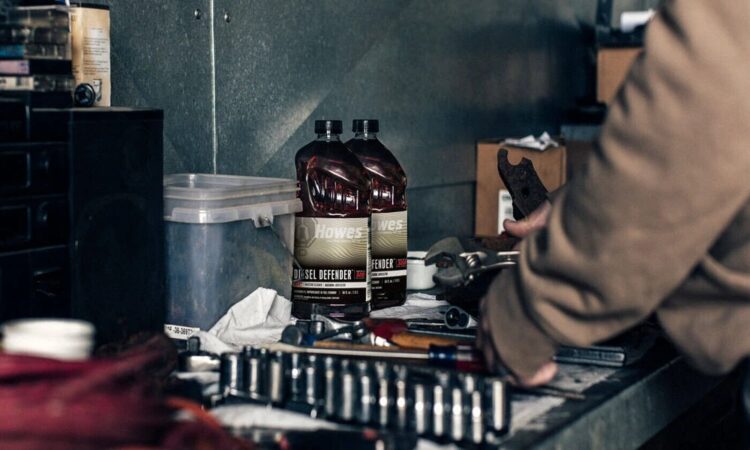
Howes Diesel Defender is a lubricator and injector cleaner that uses an IDX4 detergent. Howes states it can be used in any season alongside Diesel Treat, since their products are designed to work together.
If your maintenance has fallen behind, Meaner Power Kleaner is a one-tank deep clean for injector deposits. Howes describes it as a reset for engines with high mileage or an unknown history. Run it in the fall, and then switch to your winter routine.
Think About Bulk Storage
If you store fuel on a farm or in a fleet yard, treat the storage tank on the same schedule. Howes offers Diesel Treat Concentrate for bulk and inground tanks, in 2.5 gallon jugs, 55 gallon drums and 275 gallon totes. The ratio can reach 1 gallon per 3,000 gallons above 0°F.
Your Pre-Winter Checklist
1. Check the forecast each week from early fall.
2. Pick your trigger, such as overnight lows near freezing.
3. Add anti-gel before you fill the tank, at the rate for your temperature.
4. Use a double dose in pickups, cars and tractors.
5. Treat storage tanks and heating oil on the same schedule.
6. Put a bottle of rescue product in your cab or toolbox.
7. Run a clean-up product in the fall if maintenance is behind.
Cold weather will arrive on its own schedule. Your job is to treat the fuel before it does. I recommend Howes Products for that job, and I encourage you to start with your next fill-up.